Introduction
A Virtual Private Network (VPN) has become one of the most critical technologies in modern enterprise security architecture. It enables organizations to maintain confidential, authenticated, and tamper-proof communication across inherently insecure public networks such as the Internet.
VPNs are no longer just remote-access tools for mobile workers. They are now fundamental in supporting secure cloud connectivity, branch-to-branch communication, and hybrid data center environments. This article explores what a VPN is, the need for VPNs, and the different types of VPNs, with a technical depth aligned to CCIE Security level understanding.
What is a VPN?
At its core, a Virtual Private Network (VPN) is a technology that creates a secure, encrypted tunnel between two endpoints over an untrusted network such as the Internet. This allows data to be transmitted as if the communicating devices were on the same private network, even though they may be geographically separated.
Key VPN Attributes
- Confidentiality – Encryption ensures that even if packets are intercepted, the contents remain unintelligible.
- Integrity – Hashing mechanisms and digital signatures prevent data tampering.
- Authentication – Both endpoints validate each other’s identity before trust is established.
- Anti-Replay Protection – Sequence numbers prevent attackers from replaying old packets.
- Scalability – VPNs support connections ranging from remote access users to global enterprise site-to-site networks.
How a VPN Works – Simplified Flow
- Encapsulation: The original IP packet is encapsulated inside another packet with new headers.
- Encryption: Payload (and sometimes the headers) are encrypted.
- Tunneling: Packets are transmitted across the Internet via secure tunnels.
- Decapsulation: At the receiving end, packets are decrypted and headers stripped to reveal the original data.
Why Do We Need a VPN?
1. Secure Remote Access
With the rise of hybrid and remote work, employees frequently connect from home, airports, or public Wi-Fi. VPNs provide end-to-end secure access to enterprise resources, ensuring sensitive data is not exposed.
2. Branch Office Interconnectivity
Enterprises with multiple branches must exchange data securely. Instead of relying on expensive leased lines, site-to-site VPNs over the Internet provide cost-effective, encrypted WAN connectivity.
3. Data Privacy
Governments, ISPs, and malicious actors can inspect unencrypted traffic. VPNs prevent data exposure, making them critical for industries like finance, healthcare, and defense.
4. Bypass Geo-Restrictions and Censorship
Though more of a consumer benefit, VPNs also help organizations operating in restricted regions to access cloud services globally.
5. Secure Cloud Access
In modern enterprises, workloads span on-premises data centers and multiple cloud providers. VPNs (IPSec or SSL-based) provide secure hybrid cloud connectivity.
6. Compliance
Frameworks like HIPAA, PCI DSS, and GDPR require data encryption in transit. VPNs are often a compliance enabler.
Types of VPN
VPNs can be categorized based on implementation, tunneling protocols, and use cases. Let’s analyze them in detail.
1. Remote Access VPN
Definition
A Remote Access VPN enables individual users to securely connect to the corporate network from any location.
Protocols
- SSL VPN (TLS-based, operates on Layer 7).
- IPSec IKEv2 VPN (Layer 3, secure and efficient).
- L2TP over IPSec (legacy, still in use in some environments).
Technical Workflow (SSL VPN Example)
- User connects to the VPN gateway via HTTPS.
- Mutual authentication occurs (certificates or credentials).
- Encrypted tunnel established using TLS.
- User is assigned an internal IP address, gaining access to authorized resources.
Design Considerations
- Split-tunneling vs Full-tunneling: Performance vs Security trade-offs.
- Endpoint posture checks: Ensuring connecting devices have updated antivirus, firewalls, and patches.
- Scalability: VPN concentrators must handle thousands of concurrent connections.
2. Site-to-Site VPN
Definition
A Site-to-Site VPN connects two or more LANs across the Internet, making them operate as a single private network.
Protocols
- IPSec VPN – Industry standard for site-to-site encryption.
- GRE over IPSec – Supports multicast and routing protocols (EIGRP/OSPF/BGP).
- DMVPN (Dynamic Multipoint VPN) – Cisco’s scalable solution for spoke-to-spoke communication.
- FlexVPN – Modern Cisco VPN framework based on IKEv2.
Technical Workflow (IPSec Site-to-Site Example)
- IKE Phase 1: Peers authenticate (Pre-shared Key / Digital Certificates).
- Security Associations (SA) negotiated.
- IKE Phase 2: IPSec tunnel established.
- Data encapsulated in ESP (Encapsulating Security Payload).
- At receiving end, data decrypted and delivered.
Design Considerations
- Redundancy: Dual ISPs, tunnel failover.
- Routing Integration: Static routes vs dynamic protocols.
- MTU Issues: Fragmentation and Path MTU discovery in IPSec tunnels.
3. MPLS VPN
Definition
MPLS VPNs are provider-provisioned VPNs based on Multiprotocol Label Switching. Unlike IPSec VPNs, encryption is optional; instead, MPLS ensures isolation between customer networks.
Types
- Layer 3 MPLS VPN (BGP/MPLS VPNs) – Customer prefixes carried via MP-BGP.
- Layer 2 MPLS VPN (VPWS/VPLS) – Point-to-point and multipoint L2 services.
Technical Workflow
- Customer edge (CE) router connects to provider edge (PE).
- Labels assigned to traffic; forwarding done based on labels instead of IP lookups.
- Provider maintains VRFs (Virtual Routing and Forwarding) for tenant isolation.
Use Cases
- Large enterprises requiring scalable, managed WAN solutions.
- Financial and telecom sectors.
4. Cloud VPN
With workloads in AWS, Azure, and GCP, Cloud VPNs are essential.
Features
- IPSec-based tunnels to cloud gateways.
- High availability via redundant tunnels.
- Integration with BGP for dynamic routing.
Challenges
- Latency: Dependent on Internet performance.
- Throughput: Cloud providers impose bandwidth limits per tunnel.
- Encryption Offload: Hardware acceleration required for high-speed enterprise traffic.
5. SSL VPN
While already discussed under Remote Access, SSL VPNs deserve a separate mention due to their popularity.
Modes
- Clientless SSL VPN: Access via web browser; ideal for web applications.
- Thin Client / Port Forwarding: Extends access to specific TCP applications.
- Full Tunnel SSL VPN: Software client installed, creating a virtual NIC.
Advantages
- Works through firewalls/NAT using TCP 443.
- Simplifies remote worker connectivity.
Drawbacks
- Not ideal for heavy site-to-site traffic.
- Performance can be limited compared to hardware-accelerated IPSec.
6. DMVPN (Dynamic Multipoint VPN)
Cisco innovation allowing scalable hub-and-spoke VPNs.
Key Features
- Uses mGRE (Multipoint GRE) + NHRP (Next Hop Resolution Protocol) + IPSec.
- Spokes can dynamically build tunnels to each other without hub involvement.
- Supports routing protocols over the tunnels.
Advantages
- Reduces configuration overhead.
- Supports large-scale deployments (hundreds of branches).
7. FlexVPN
Cisco’s next-generation VPN solution based on IKEv2.
Features
- Unified framework for site-to-site, remote access, and DMVPN.
- Supports modern encryption (AES-GCM, SHA-2).
- Extensible authentication via EAP.
Why FlexVPN?
- Simplified configuration compared to traditional IPSec/DMVPN.
- Future-proof design aligned with modern cryptography standards.
8. Mobile VPN
Definition
Specialized VPNs optimized for mobile devices.
Features
- Seamless handoff between Wi-Fi, 4G, 5G without dropping sessions.
- Battery and bandwidth optimized protocols.
- Examples: WireGuard, SSL VPN clients on smartphones.
9. Emerging VPN Technologies
a) WireGuard
- Lightweight, high-performance VPN.
- Uses Curve25519 for key exchange, ChaCha20 for encryption.
- Extremely simple configuration compared to IPSec.
b) Zero Trust VPNs (ZTNA)
- Moving beyond perimeter-based security.
- Provides identity-aware, context-aware access control.
- Often integrated with SD-WAN and SASE frameworks.
VPN Security Considerations
Even with strong technology, VPN deployments often fail due to poor design or misconfiguration.
Key areas to consider:
- Strong Authentication – Use digital certificates or MFA, not just PSKs.
- Cryptographic Agility – Avoid outdated protocols (e.g., DES, 3DES, MD5).
- Scalability – Ensure VPN concentrators and firewalls can handle peak loads.
- Logging & Monitoring – Integrate VPN logs with SIEM for anomaly detection.
- User Segmentation – Apply ACLs and role-based policies after tunnel termination.
- High Availability – Redundant concentrators and tunnels to avoid downtime.
Real-World VPN Challenges
- Performance Bottlenecks: Encryption/decryption consumes CPU cycles.
- NAT Traversal: IPSec struggles with NAT; IKEv2 and SSL VPNs handle better.
- Key Management: Large deployments require PKI infrastructure.
- User Behavior: Split tunneling, if not managed properly, can create data leaks.
Conclusion
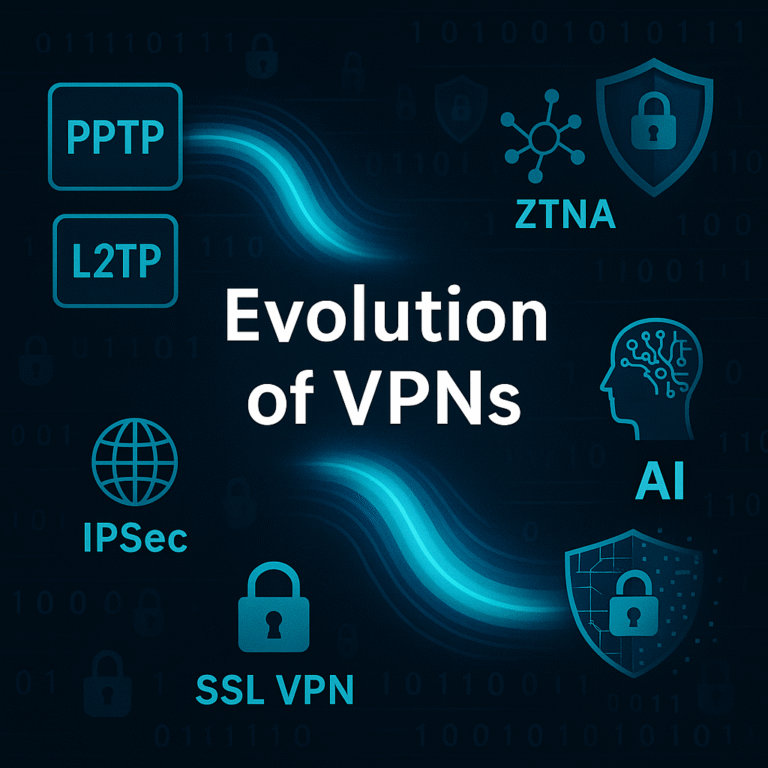
From early point-to-point tunnels to today’s cloud-integrated, identity-aware VPNs, the evolution of VPN technology reflects the growing need for secure, scalable, and high-performance connectivity.
For a CCIE Security professional, understanding VPNs isn’t just about configuring IPSec on a router or firewall. It is about:
- Choosing the right VPN technology for the right scenario.
- Ensuring cryptographic best practices.
- Balancing performance with security.
- Preparing for the next wave of VPN evolution – Zero Trust and SASE-driven architectures.
VPNs are here to stay, but the way we architect them will continue to evolve with threats, compliance requirements, and digital transformation initiatives.
📌FAQs
Q1. What is the main purpose of a VPN?
A VPN ensures confidentiality, integrity, and authentication by encrypting traffic over untrusted networks like the Internet.
Q2. What are the major types of VPNs?
The most common types include Remote Access VPN, Site-to-Site VPN, SSL VPN, IPSec VPN, MPLS VPN, Cloud VPN, DMVPN, and FlexVPN.
Q3. How is SSL VPN different from IPSec VPN?
SSL VPNs use TLS at Layer 7 and are ideal for remote access, while IPSec VPNs operate at Layer 3 and are widely used for site-to-site connectivity.
Q4. What is DMVPN and why is it used?
Dynamic Multipoint VPN (DMVPN) allows dynamic spoke-to-spoke tunnels without manual configuration, making it highly scalable for large enterprises.
Q5. What role does ZTNA play compared to traditional VPNs?
Zero Trust Network Access (ZTNA) replaces perimeter-based VPN models with identity-aware, context-based access, ensuring users only access resources they are explicitly authorized for.
Q6. How does AI improve VPN security?
AI-powered analytics can detect unusual VPN traffic patterns, prevent compromised credential abuse, and optimize VPN performance by dynamically adjusting routing and security policies.
Q7. Is MPLS VPN encrypted?
No. MPLS VPNs provide isolation through label switching, not encryption. Many organizations combine MPLS with IPSec for stronger security.
Q8. What is the difference between Split Tunnel and Full Tunnel VPN?
Split tunnel routes only corporate traffic through the VPN, while full tunnel forces all user traffic through the VPN for complete inspection and security.
Q9. Is WireGuard better than traditional IPSec VPN?
WireGuard is faster and simpler, using modern cryptography like ChaCha20 and Curve25519, but IPSec remains more mature and widely adopted in enterprise-grade deployments.
Q10. What is the future of VPNs in enterprise networks?
VPNs are evolving into AI-driven, Zero Trust, and SASE-based architectures, where AI enhances threat detection and ZTNA ensures identity-first access instead of broad network tunnels.